42 min read
Little Caesars x Spider-Man: How to build a Collaboration beyond a logo
Little Caesars turned its Spider-Man partnership into pizza, collectibles, gaming, and Peter Parker’s apartment. Here’s why the campaign works.
Little Caesars didn’t sponsor Spider-Man. It entered Spider-Man’s world.
Most movie partnerships are painfully predictable.
Take the character.
Put them on the packaging.
Rename an existing product.
Release a commercial.
Call it a collaboration.
Little Caesars could have done exactly that with Spider-Man: Brand New Day.
Spider-Man on the pizza box. Maybe a red-and-blue cup. A promotional code with the word “WEB” somewhere in it.
Campaign finished.
Instead, Little Caesars built something much bigger around the partnership.
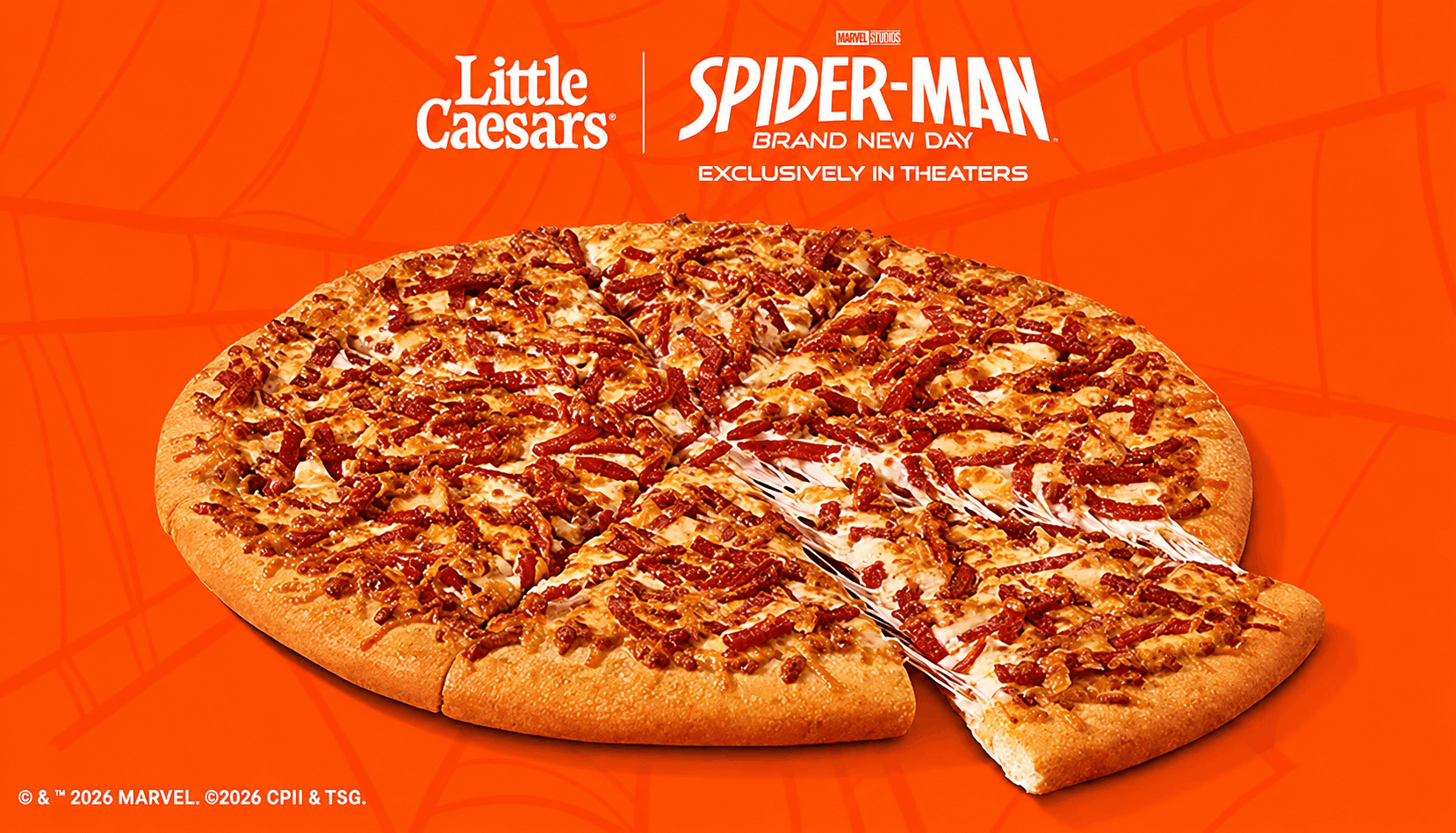
There was a new Webberoni Pizza designed around Spider-Man’s web.
Special-edition movie packaging.
Three collectible posters released across different weeks.
An in-app game.
A digital challenge that could unlock free delivery.
And then, in Brooklyn, Little Caesars recreated Peter Parker’s apartment and invited fans inside.
Hundreds reportedly showed up, with lines wrapping around a city block.
That last part changes how you should look at the campaign.
Little Caesars didn’t simply license Spider-Man’s image.
It borrowed the world around him.
And that is a much more interesting way to build a brand partnership.
What was the Little Caesars x Spider-Man collaboration?
Little Caesars partnered with Sony Pictures around the July 31 theatrical release of Spider-Man: Brand New Day.
The centerpiece on the menu was the Webberoni Pizza, launched nationally in June for $8.99 at participating locations.
Instead of simply renaming a regular pepperoni pizza, Little Caesars modified the product itself. Shredded pepperoni and toasted cheeses were arranged across the pizza in a web-inspired pattern.
Customers ordering online could even add the web-style topping to other large pizzas.
That's a small detail, but an important one.
The intellectual property didn't just appear next to the product.
It changed the product.
The wider campaign included Spider-Man-inspired pizza boxes, three limited-edition posters rotating weekly, an in-app mini-game, and a Slice Runner Challenge that could earn qualifying customers free delivery on a future order.
Already, this is more layered than the typical movie promotion.
But Little Caesars then took the campaign out of the restaurant entirely.
Then they built Peter Parker’s apartment
On June 27, Little Caesars and Sony Pictures transformed part of Brooklyn's Greenpoint Terminal Warehouse into a full-scale recreation of Peter Parker's apartment.
The one-day experience invited fans to walk through the space, find details connected to Peter Parker and the upcoming film, take photos, recreate a scene inspired by the movie's trailer, and try the Webberoni Pizza.
The production reportedly drew hundreds of fans, with attendees lining up around the block.
The apartment itself wasn't treated like a generic Spider-Man photo booth.
The creators filled it with the details that make Peter Parker's world recognizable: a tech setup, books, webs, an unmade bed, sparse cabinets, and pizza boxes scattered through the kitchen.
That's what makes this activation work.
Fans weren't being asked to stand beside a Spider-Man cutout.
They were being invited to imagine:
What would it actually feel like to walk into Peter Parker's life?
Little Caesars placed itself inside the answer.
Most movie partnerships borrow recognition
The basic logic behind entertainment licensing is obvious.
Spider-Man has enormous cultural recognition.
Little Caesars has pizza.
Put the two together and both parties gain something.
Sony receives another promotional channel for the film.
Little Caesars gains access to a character people already care about.
There is nothing wrong with that model.
But recognition alone produces relatively shallow collaborations.
If the entire campaign consists of putting Spider-Man on a Little Caesars box, customers understand the commercial transaction immediately:
Little Caesars paid to use Spider-Man.
The brand gets attention, but it doesn't necessarily create an experience worth remembering.
The stronger approach is to ask:
What parts of this fictional world can our brand participate in naturally?
For Little Caesars, pizza provides a surprisingly good entry point.
Peter Parker is young.
He's a New Yorker.
Pizza already belongs within the cultural environment surrounding the character.
The connection doesn't require an elaborate explanation.
Then Little Caesars stretched that connection further.
The pizza looks like a web.
The box becomes collectible.
The app becomes a game.
The physical activation becomes Peter's apartment.
The product partnership gradually becomes a world-building exercise.
The Webberoni Pizza is more important than it looks
Limited-time menu items tied to movies are nothing new.
But there is a difference between putting a character's name in front of a product and making the product itself communicate the collaboration.
Imagine the weaker version:
Spider-Man Pepperoni Pizza.
It's regular pizza in Spider-Man packaging.
Nothing about the food needs the partnership to exist.
The Webberoni takes a simple visual characteristic associated with Spider-Man — his web — and translates it into something Little Caesars can actually make.
Shredded pepperoni and cheese become the web.
It's not revolutionary product innovation.
It doesn't need to be.
The important part is that the collaboration remains visible after the customer opens the box.
That creates another moment worth photographing.
And in modern promotional marketing, that matters.
The physical product is no longer just what gets consumed.
It's also potential social content.
Collectibles give customers a reason to return
Little Caesars also avoided placing every promotional asset into one launch-day bundle.
Beginning July 6, customers buying a Webberoni Pizza through qualifying channels could receive one of three limited-edition posters, with a different design rotating each week.
That changes the behavioral economics of the promotion.
One poster creates an incentive to purchase once.
Three posters released sequentially create a reason for a fan to return.
This is where collectibles become more than merchandise.
They're a frequency mechanic.
The customer isn't simply thinking:
I want a Spider-Man poster.
They may start thinking:
I already have the first one. I might as well get the second.
Restaurants usually depend on habit, convenience, pricing, offers, and menu preference to drive repeat purchases.
A limited-time collaboration gives them another lever:
completion.
Collectors hate incomplete sets.
That psychological pull can turn a promotional asset into repeat traffic.
The app wasn't left out of the campaign
One of the easiest mistakes in experiential marketing is creating an impressive physical activation that exists almost completely separately from the company's actual customer infrastructure.
The event gets attention.
The agency gets case-study photos.
People post about it.
Then nothing happens inside the app, website, loyalty program, or ordering journey.
Little Caesars made the Spider-Man collaboration more connected.
Its app featured a themed mini-game and the Slice Runner Challenge, with qualifying participation tied to a future free-delivery reward.
That matters because Little Caesars isn't in the business of selling immersive experiences.
It sells pizza.
Eventually, the campaign needs to move people toward a transaction.
The best experiential campaigns don't treat brand awareness and conversion as opposing ideas.
They build a path between them.
See the campaign.
Interact with the IP.
Open the app.
Play.
Order.
Earn a reason to order again.
Now the collaboration has a customer journey.
Even the RSVP was part of the story
One of the smartest details of the apartment activation happened before anyone entered the warehouse.
Fans could RSVP through what appeared to be a real Zillow listing for Peter Parker's apartment.
The stunt connected directly to Peter Parker's search for a place of his own and allowed the fictional apartment to exist online before fans experienced it physically.
This is a tiny executional detail compared with building an entire apartment.
Strategically, it's excellent.
Most brands would promote an event with a normal registration page.
Date.
Address.
Email.
RSVP.
Little Caesars asked:
What would registration look like if this apartment actually existed?
Zillow becomes part of the narrative.
That is the difference between putting a theme around an activation and carrying the idea through the entire experience.
Good experiential marketing frequently lives in those small details.
The customer should feel like the concept continues wherever they look.
The collaboration had multiple entry points
Not everyone could travel to Brooklyn.
Not everyone collects posters.
Not everyone wants to play a game in a pizza app.
Not everyone even wants the Webberoni Pizza.
That's fine.
The campaign offered multiple ways into the same idea.
Someone could encounter Spider-Man through:
The pizza itself
The pizza box
The collectible posters
The Little Caesars app
The Brooklyn activation
The Zillow listing
Social content
Influencer coverage
Press coverage
Little Caesars also brought content creators into the campaign, including apartment-tour creator Caleb Simpson, extending the physical activation to audiences who would never attend it themselves.
This is where integrated campaigns become considerably stronger than isolated stunts.
Every touchpoint does not need to achieve the same thing.
The billboard can generate awareness.
The influencer can create curiosity.
The activation can deepen engagement.
The collectible can drive purchase.
The app can create retention.
The product can generate revenue.
One idea. Different jobs.
That is much more sophisticated than repeating the same key visual across six channels and calling it integrated marketing.
The apartment turned fans into distribution
There is another reason experiential campaigns like this are attractive to brands.
People attending them frequently become part of the media plan.
Walk into Peter Parker's apartment and what are you likely to do?
Take a photo.
Film the room.
Look for Easter eggs.
Recreate a scene.
Post it.
Send it to another Spider-Man fan.
Little Caesars essentially built an environment designed to create content without asking attendees to “create content.”
That's an important distinction.
Customers rarely want to act like unpaid members of your marketing department.
But they will photograph something genuinely worth showing someone.
The apartment gives them that reason.
The physical experience therefore has two audiences.
The first audience is standing inside the warehouse.
The second audience sees the activation through somebody else's phone.
Hundreds can attend an event.
Millions can potentially encounter the resulting content.
That is how experiential marketing begins to scale.
This isn't really about Spider-Man
The campaign also works because Little Caesars understood its own role.
A brand collaboration can easily become dominated by the larger partner.
Let's be realistic.
Spider-Man has significantly more cultural gravity than Little Caesars.
If the pizza chain simply placed Spider-Man artwork everywhere, customers might remember the movie and barely register the advertiser.
So Little Caesars needed to create places where pizza remained essential to the idea.
The Webberoni accomplishes that.
So does the apartment.
A Peter Parker apartment with Little Caesars boxes sitting naturally inside it makes the restaurant part of the environment instead of an awkward sponsor logo attached outside it.
Fans get Spider-Man.
Little Caesars still gets product relevance.
Neither side has to fight for attention.
That balance is one of the hardest parts of partnership marketing.
Most collaborations start with the brands. Better ones start with the fan.
Imagine the planning conversation behind an average licensed partnership:
We have Spider-Man rights. What can we put Spider-Man on?
Now change the question:
What would a Spider-Man fan actually want to do?
That produces very different ideas.
They might want to see Peter's apartment.
Search for Easter eggs.
Collect artwork.
Recreate moments from the movie.
Eat something themed around the character.
Play a game.
Take photos that make it look like they stepped into Spider-Man's world.
Little Caesars built across several of those behaviors.
That's why the partnership doesn't feel entirely like an advertisement.
The fan receives something from it.
Entertainment.
Access.
Collectibility.
Novelty.
Participation.
Good partnership marketing creates value for all three parties:
The brand.
The entertainment property.
The audience.
If only the first two benefit, customers can usually feel it.
This is Experiential Marketing with a commercial backbone
It's easy to look at a recreation of Peter Parker's apartment and focus entirely on the spectacle.
But the broader campaign is more interesting because the experience was connected to commercial mechanics.
The Webberoni was purchasable nationally.
The posters encouraged repeat orders.
The app created another engagement point.
The challenge could encourage another transaction.
The special packaging carried the partnership into everyday stores.
The physical event created earned attention.
That gives Little Caesars something many experiential campaigns lack:
a path from attention to revenue.
An activation can be brilliant creatively and still be commercially weak.
Foot traffic and Instagram impressions sound good in a recap deck.
Businesses ultimately need to ask what the campaign changes.
Does it drive trial?
Frequency?
App adoption?
Orders?
Brand preference?
Cultural relevance?
Ideally, an activation is designed with those outcomes in mind before somebody starts building the set.
What Marketers can learn from Little Caesars x Spider-Man
1. Don't Just License the Character. Find the World.
The logo, celebrity, or intellectual property is only the starting point.
Ask what objects, behaviors, locations, rituals, and stories surround it.
That's where the more original ideas usually live.
2. Make the Product Participate
A collaboration becomes stronger when the product itself changes.
The Webberoni didn't simply carry Spider-Man branding.
The visual identity of Spider-Man changed how the pizza was constructed.
Small difference.
Big improvement.
3. Give Different Channels Different Jobs
Your app doesn't need to recreate the physical experience.
Your activation doesn't need to close every sale.
Build an ecosystem where channels support one another rather than duplicate one another.
4. Turn Collectibles Into Repeat-Purchase Mechanics
Limited editions can do more than create scarcity.
Sequential releases can encourage customers to return throughout the campaign.
5. Design Experiences People Naturally Want to Share
Don't begin with:
“How do we make this go viral?”
Build something people genuinely want a photo of.
Distribution becomes much easier afterward.
6. Carry the Idea Into the Smallest Touchpoints
The Zillow RSVP is a perfect example.
It wasn't necessary.
That's exactly why it was memorable.
The strongest campaigns often become convincing through details most brands would have ignored.
7. Make Sure Your Brand Still Matters
Borrowed cultural relevance is useful only if some of it transfers back.
The audience should remember why your company belonged in the collaboration.
Brand Partnerships should create something neither brand could build alone
Little Caesars already had stores.
Pizza.
An app.
Customers.
Distribution.
Spider-Man already had characters.
A fictional universe.
Fans.
Cultural recognition.
The campaign worked because the partnership combined those assets into something neither side would have created in isolation.
Little Caesars gave Spider-Man a real product people could eat.
Spider-Man gave Little Caesars a world people wanted to enter.
Then the campaign connected the two across product, retail, digital, collectibles, content, and experience.
That's the lesson.
A partnership shouldn't simply make two brands visible beside each other.
It should unlock an idea that only makes sense because both brands are there.
Little Caesars could have sponsored Spider-Man: Brand New Day.
Instead, it built the Webberoni.
Released collectibles.
Turned its app into part of the campaign.
Listed Peter Parker's apartment on Zillow.
Then built that apartment in Brooklyn and let fans walk through the door.
Most movie partnerships borrow the character.
Little Caesars borrowed the world.
That's how a collaboration becomes more than a logo swap.
At Nitroger, we help brands turn positioning, cultural opportunities, and customer behavior into campaigns built to do more than generate impressions. Because the strongest marketing partnerships aren't the ones with the biggest names attached — they're the ones that give customers a compelling reason to participate.